
Best On-Grid Solar Inverter in India 2026: How to Choose
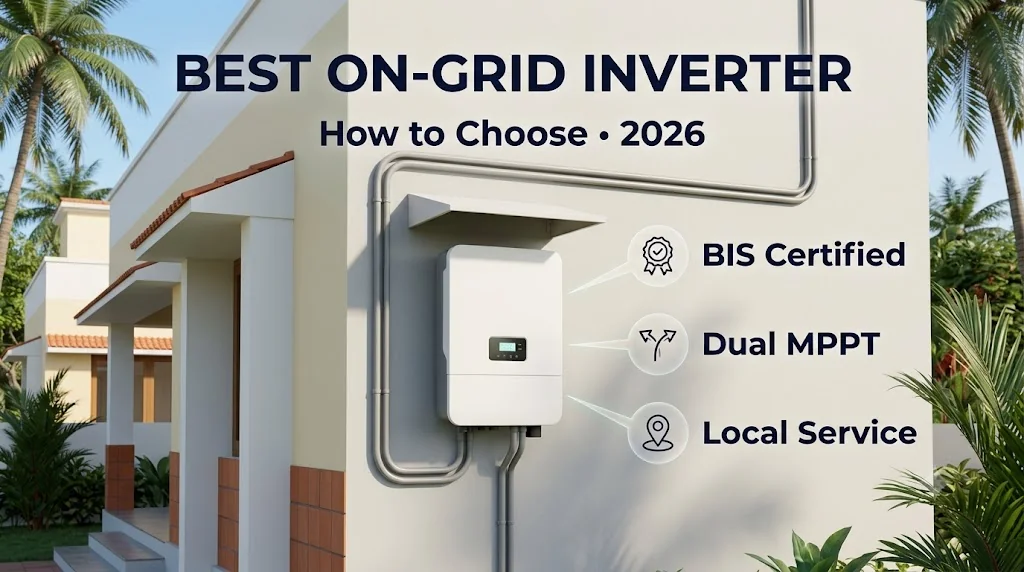
Short answer: for most Tamil Nadu homes (3-5kW), the best on-grid inverter is a BIS-certified model from a well-supported brand such as Growatt, Solis, Sungrow or Havells, with dual MPPT, IP65 protection, a good app and at least a 5-year warranty. Fronius and SMA are premium choices for buyers who want top-end build quality. Efficiency is about 97.5-98.5% across good brands, so local service support matters more than small spec differences.
Popular On-Grid Inverter Brands in India (2026)
| Brand | Positioning | Strengths | Good for |
|---|---|---|---|
| Growatt | Value, very popular | Large residential volumes, wide model range, app monitoring | Most 1-10kW homes |
| Solis (Ginlong) | Value-premium | Strong residential range, good reported efficiency | 3-10kW homes |
| Sungrow | Value-premium | Big global maker, strong in commercial | Larger homes, commercial |
| GoodWe | Value | Wide range including hybrids | Homes planning batteries |
| Havells | Indian brand | Strong service network, familiar brand | Buyers who want Indian brand support |
| Exide | Indian brand | Solar inverters designed for modern high-watt panels; battery expertise | One-brand Exide systems, hybrids |
| Fronius | Premium (Austria) | Build quality, long life reputation | Premium homes, commercial |
| SMA | Premium (Germany) | Long track record, engineering quality | Premium homes, large plants |
This list is not a ranking. Brand availability and service quality vary by district; always confirm BIS certification and local service before buying.
8 Features That Actually Matter
- BIS certification. Grid-connected inverters sold in India must carry BIS registration (the relevant Indian standards cover safety and grid connection). Ask for the certificate of the exact model.
- Dual MPPT. Two independent inputs let panels on different roof faces, or with some shade, perform better.
- Wide AC voltage range. In many Tamil Nadu areas grid voltage swings high at noon. An inverter with a suitable, correctly set voltage window trips less often. See voltage problems and hybrid solar.
- IP65 rating. Protection against dust and rain if mounted outdoors; even better, mount it in a shaded, covered spot.
- Efficiency above 97%. Every good brand meets this; do not pay extra for 0.2%.
- App and Wi-Fi monitoring. Lets you see daily units and spot problems early.
- Warranty. 5 years minimum; 7-10 years (or extendable) is better.
- Local service. Who replaces it in Cuddalore within days, not weeks? This matters more than anything above.
Inverter Size by System
| Solar system | Typical inverter | Connection |
|---|---|---|
| 1 - 2kW | 2kW single-phase | Single phase |
| 3kW | 3kW (or 3.6kW for future expansion) single-phase | Single phase |
| 5kW | 5kW single-phase (or three-phase if required) | Single or three phase |
| 10kW | 10kW three-phase | Three phase |
Matching inverter size to panel capacity matters: a heavily undersized inverter "clips" the noon peak, and a heavily oversized one costs more for no gain. Sizing guides: 2kW, 5kW, 10kW.
What Does an On-Grid Inverter Cost? (2026 Market Range)
| Inverter size | Value brands | Premium brands |
|---|---|---|
| 3kW single-phase | about ₹25,000 - ₹40,000 | about ₹55,000 - ₹80,000 |
| 5kW single-phase | about ₹35,000 - ₹55,000 | about ₹70,000 - ₹1,00,000 |
| 10kW three-phase | about ₹60,000 - ₹1,00,000 | about ₹1,20,000 - ₹1,80,000 |
Ranges are approximate and change with stock and models. In a complete system quote the inverter is usually 12-18% of the price. A premium inverter is worth it for large or commercial systems where downtime is costly; for most 3-5kW homes, a good value brand with strong local service is the smarter spend.
On-Grid vs Hybrid Inverter
| On-grid inverter | Hybrid inverter | |
|---|---|---|
| Battery | No | Yes |
| Works in power cut | No (anti-islanding safety) | Yes, for backed-up loads |
| Cost | Lower | Higher |
| Best for | Lowest bill, fastest payback | Areas with frequent cuts |
An on-grid inverter must shut down during a power cut so it does not send power into lines that TNEB staff may be repairing. This is a safety feature, not a fault. If cuts are frequent, read Exide solar battery review and on-grid vs hybrid.
Micro-Inverters and Optimisers
For roofs with heavy or changing shade, micro-inverters (one per panel) or optimisers can recover lost units, at a higher cost. For a clear, shade-free terrace, a good string inverter is the better value. Details: Enphase micro-inverter review.
Where to Mount Your Inverter (Tamil Nadu Tips)
- Shade and airflow: heat reduces inverter output and life. Mount it on a shaded wall or indoors near the distribution box, never in direct afternoon sun.
- Above flood level: in coastal Cuddalore, keep it well above any water that can collect during heavy rain.
- Short AC cable: close to your meter/DB to reduce losses.
- Wi-Fi reach: so monitoring keeps working.
- Clearance: leave space around it for cooling and service.
More monsoon safety: solar panels in rain and cyclones.
Inverter Warning Signs
| Sign | Possible cause | What to do |
|---|---|---|
| Switches off at noon on sunny days | High grid voltage | Ask installer to check settings; raise a TNEB voltage complaint |
| Units suddenly drop | String fault, loose connector, shading | Check app, call installer |
| Fan noise or very hot body | Poor ventilation | Relocate to shade |
| Error codes on display/app | Earth fault, insulation fault | Do not reset repeatedly; call installer |
Frequently Asked Questions
Which is the best on-grid solar inverter in India?
How long does a solar inverter last?
What size inverter do I need for a 3kW solar system?
Does the inverter brand affect the PM Surya Ghar subsidy?
Why does my on-grid inverter switch off at noon?
Get the Right Inverter for Your Roof
We match the inverter to your panels, roof layout, grid voltage and budget, and we service what we install, from our office in Kondur, Cuddalore. Official partner of TATA Power Solar and Exide. Call or WhatsApp +91 7904369094.
Get a Free Rooftop Assessment
Our engineers will visit your site, analyze shadow-free area, and provide a detailed solar report.
Book Free AssessmentTags
Ready to Switch to Solar?
Get a customized solar solution for your home. Save up to 90% on electricity bills!
- Free Site Visit
- Govt. Subsidy Support
- 25 Years Warranty