PM Surya Ghar Scheme in Cuddalore 2026: Apply & Get Subsidy
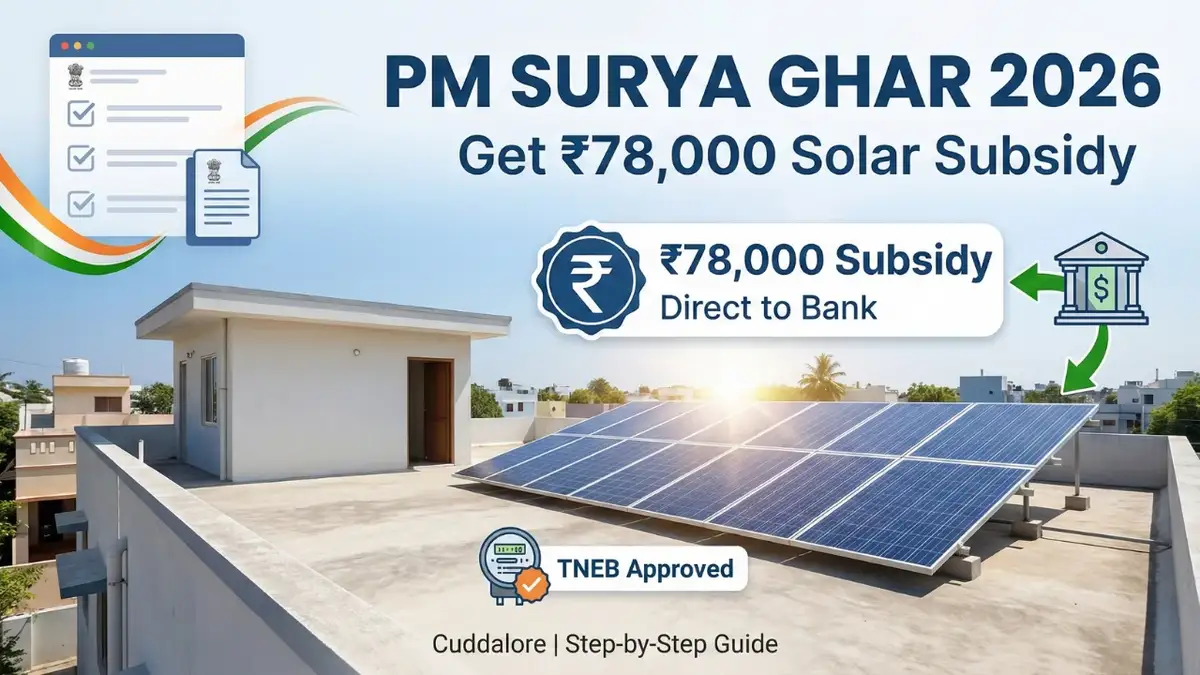
October 2026 update: Tamil Nadu has added a ₹22,000 state top-up (G.O. 102) on top of the ₹78,000 PM Surya Ghar subsidy, so Cuddalore homes installing 3kW or more can now get up to ₹1 lakh. It applies to registrations from 5 August 2026 and is reported to be limited to the first 1 lakh homes. Full rules: ₹1 lakh solar subsidy in Tamil Nadu.
Welcome to 2026. If you are a homeowner in Cuddalore, Neyveli, or Pondicherry, you have likely heard about the massive push for solar energy. But amidst the headlines, there is often confusion. Is the electricity really free? Is the subsidy amount guaranteed? How long does the TNEB process actually take?
The PM Surya Ghar: Muft Bijli Yojana has evolved into one of the most successful green energy initiatives in India. For residents of Tamil Nadu, specifically in high-solar-yield districts like Cuddalore, this scheme is not just an environmental choice-it is a financial no-brainer.
At Surya's Solar, a registered vendor on the official PM Surya Ghar portal with 150+ installations under the scheme, we have guided over a hundred local families through this process. We’ve seen the approvals, the inspections, and most importantly, the subsidy credits hitting bank accounts.
In this exhaustive 2026 guide, we will walk you through every single detail of the scheme, ensuring your application is approved on the first try.
The Core Promise: What is PM Surya Ghar 2026?
The "Muft Bijli Yojana" (Free Electricity Scheme) aims to power 1 crore households across India with rooftop solar. The government’s goal is simple: reduce the burden on the national grid and lower electricity bills for the common man.
In 2026, the scheme has been streamlined. It is no longer just about "getting solar"-it is about becoming an independent power producer.
Key Highlights for 2026:
- Direct Benefit Transfer (DBT): The subsidy is NOT given to the vendor; it is credited directly to your bank account within 30 days of commissioning.
- Increased Cap: The subsidy applies effectively up to 3kW capacity, covering the bulk of residential system costs.
- Digital First: The entire process, from application to feasibility to inspection requests, is handled via the National Portal.
2026 Subsidy Breakdown: The Exact Math
Many customers ask us, "Sir, if I install 5kW, do I get more money?" It is crucial to understand how the subsidy caps work to plan your budget.
As of the latest January 2026 guidelines, the financial assistance is structured as follows:
| System Capacity | Central Subsidy (Fixed) | Who Should Choose This? |
|---|---|---|
| 1 kW | ₹30,000 | Very small homes with monthly usage < 150 units. Good for lights, fans, and strict budget. |
| 2 kW | ₹60,000 | Small 2BHK homes. Can run a Refrigerator, TV, Laptop, and Washing Machine (No AC). |
| 3 kW | ₹78,000 (Maximum) | The Gold Standard. Ideal for 3BHK homes. Can run a 1.5 Ton AC, Mixie, Fridge, and general loads. |
| Above 3 kW | ₹78,000 (Fixed Cap) | Large homes, Villas, or houses with 2+ ACs. Even for a 10kW system, the subsidy remains ₹78,000. |
Analyst Note: The "sweet spot" for ROI (Return on Investment) is the 3kW system. You get the maximum possible government contribution (₹78,000), which covers nearly 40% of the total project cost.
Yes Are You Eligible? (The Checklist)
Before you upload documents, run through this checklist. TNEB Cuddalore is strict about these parameters, and deviations can lead to rejection.
1. Consumer Connection Status
You must be a residential consumer with an active TANGEDCO (TNEB) connection.
- Eligible: Tariff 1A (Domestic).
- Not Eligible: Commercial, Industrial, or Temporary tariff connections.
2. Sanctioned Load
Your solar system capacity should generally align with your sanctioned load.
- Scenario: Your TNEB card says "1kW Sanctioned Load", but you want a 3kW Solar Plant.
- Solution: You must apply for a Load Enhancement at your local EB office before or during the solar application. We handle this paperwork for our clients.
3. Roof Ownership & Structure
You must have roof rights.
- Concrete Roof: Ideal.
- Sheet Roof: Requires specialized aluminium rails (short rails) or penetrating structures.
- Apartments: You need a NOC (No Objection Certificate) from the association if using a common roof.
4. The "DCR" Mandate
This is critical. To get the subsidy, your solar panels MUST be "Made in India" using Indian solar cells. These are called DCR (Domestic Content Requirement) modules.
- If you install imported components (even high-end foreign brands), you forfeit the subsidy.
- At Surya's Solar, we only stock ALMM-approved DCR modules (like Tata Power, Adani, Waaree, Premier) for residential projects to guarantee your eligibility.
The Documentation Packet
In 2026, the portal rejects blurry or outdated documents instantly using AI checks. Ensure you have clear PDFs/JPGs of:
- Recent Electricity Bill: Must be from the last 2 months. The Consumer Number and Name must be clearly visible.
- Aadhar Card: Both sides. The address isn't critical, but the ID proof is.
- Bank Passbook or Cancelled Cheque: This is where the money goes. The name on the bank account MUST MATCH the name on the electricity bill. This is the #1 reason for delay.
- Property Tax Receipt: Sometimes requested by TNEB Engineers in Cuddalore to verify premises ownership.
Step-by-Step Application Process (The Cuddalore Guide)
We believe in transparency. While we do this work for our clients, it is empowering for you to know the process.
Phase 1: The Digital Application
- Register: Visit pmsuryaghar.gov.in. Select "State: Tamil Nadu" and "District: Cuddalore". Enter your Consumer Number.
- Mobile OTP: Register with the mobile number linked to your TNEB account.
- Apply: Fill in the basic details (Sanctioned Load, Solar Capacity). Upload the Electricity Bill.
- Feasibility Approval: The application goes to the local TNEB Assistant Engineer (AE). They check if the local distribution transformer can handle your solar power. in 2026, this approval is usually auto-generated or cleared within 3-7 days.
Phase 2: Installation
- Choose Vendor: Once approved, you select a vendor. Search for "Surya's Solar" or your preferred certified installer.
- Agreement: We sign a model agreement with you (a portal requirement).
- Installation: Our team arrives. We mount the structure, fix the DCR panels, wire the DCDB/ACDB boxes, and earth the system (Chemical Earthing).
- Submission: We upload photos of the installed plant, the earthing pits, and the "Solar Asset" tag to the portal.
Phase 3: The Net Meter Inspection
This is the most crucial physical step.
- We submit the "Work Completion Report" online.
- You pay the Net Meter charges to TNEB (approx ₹1,500 - ₹3,000 depending on single/three-phase).
- The TNEB AE and Tester visit your home. They check:
- Is the earthing value below 5 Ohms?
- Is the inverter working efficiently?
- Are the safety breakers (MCBs/SPDs) installed?
- If satisfied, they replace your old meter with a Bi-Directional Net Meter.
Phase 4: Subsidy Release
- TNEB issues a "Commissioning Certificate" online.
- You log in one last time and enter your Bank Account details and upload a Cancelled Cheque.
- Wait 15-30 Days. The Central Government processes the batch, and the funds hit your account via DBT.
Warning: Common Pitfalls & Rejection Reasons
Why do some neighbors complain about "pending subsidies"? Usually, it's a paperwork error.
- Name Mismatch: If TNEB Bill says "R. Senthil" and Bank Account says "Senthil Kumar R", the system might flag it. We advise creating a joint account or updating the TNEB name if strict matching is required.
- Shadow Casting: If a tree or neighbor's building casts a shadow on panels during the TNEB inspection, they may deny commissioning until panels are relocated.
- Non-DCR Panels: Some dishonest vendors install cheaper imported panels to increase their margin. The portal requires scanning the barcode of every panel. If it's not DCR, the system blocks the subsidy instantly. Always verify the DCR label on your panels.
What About "Free Electricity"? How Does Net Metering Work?
The subsidy is a one-time cash benefit. The real "Free Electricity" comes from the Net Metering mechanism.
- Daytime: Your panels generate power (e.g., 15 units). Your house uses 5 units. The extra 10 units go to the TNEB grid.
- Nighttime: Solar stops. Your house pulls power from TNEB.
- The Calculation: At the end of the billing cycle (2 months), TNEB calculates:
(Exported Units - Imported Units).- If you Exported more: You pay ₹0 (plus fixed charges). The balance units are carried forward (Banked).
- If you Imported more: You only pay for the net difference.
Why Choose Surya's Solar for Your 2026 Application?
The PM Surya Ghar portal is user-friendly, but the TNEB liaisoning in Cuddalore requires local expertise.
- Local Office: We are Cuddalore-based. We know the local AE and the specific documentation they prefer.
- Turnkey Service: We don't just hammer panels. We handle the Load Enhancement, the Net Meter application, and the Subsidy Inspection coordination.
- Peace of Mind: We strictly use Tier-1 DCR panels (Tata/Adani/Waaree) to ensure your subsidy is never rejected.
Solar is a 25-year investment. Start it right.
Ready to wipe out your electricity bill in 2026? Contact us today for a free site visit and feasibility check!
Frequently Asked Questions
Can I apply if my electricity bill is in my father's name?
How long does TNEB take to approve feasibility?
Can I get subsidy for a 5kW system?
What if I already installed solar last year without knowing about the scheme?
Is there a deadline for 2026?
Related Articles
- Calculate Your Solar ROI - Understand the complete financial breakdown
- Solar EMI Options - Finance your system after subsidy
- TNEB Net Meter Process - Complete liaisoning guide
Disclaimer: Subsidy rules and amounts are subject to change by MNRE directives. The information provided here is effective as of January 2026. Please consult our team for the latest live updates.
Get a Free Rooftop Assessment
Our engineers will visit your site, analyze shadow-free area, and provide a detailed solar report.
Book Free AssessmentTags
Ready to Switch to Solar?
Get a customized solar solution for your home. Save up to 90% on electricity bills!
- Free Site Visit
- Govt. Subsidy Support
- 25 Years Warranty