
How to Read Your TNEB Solar Bill: Import vs Export Units
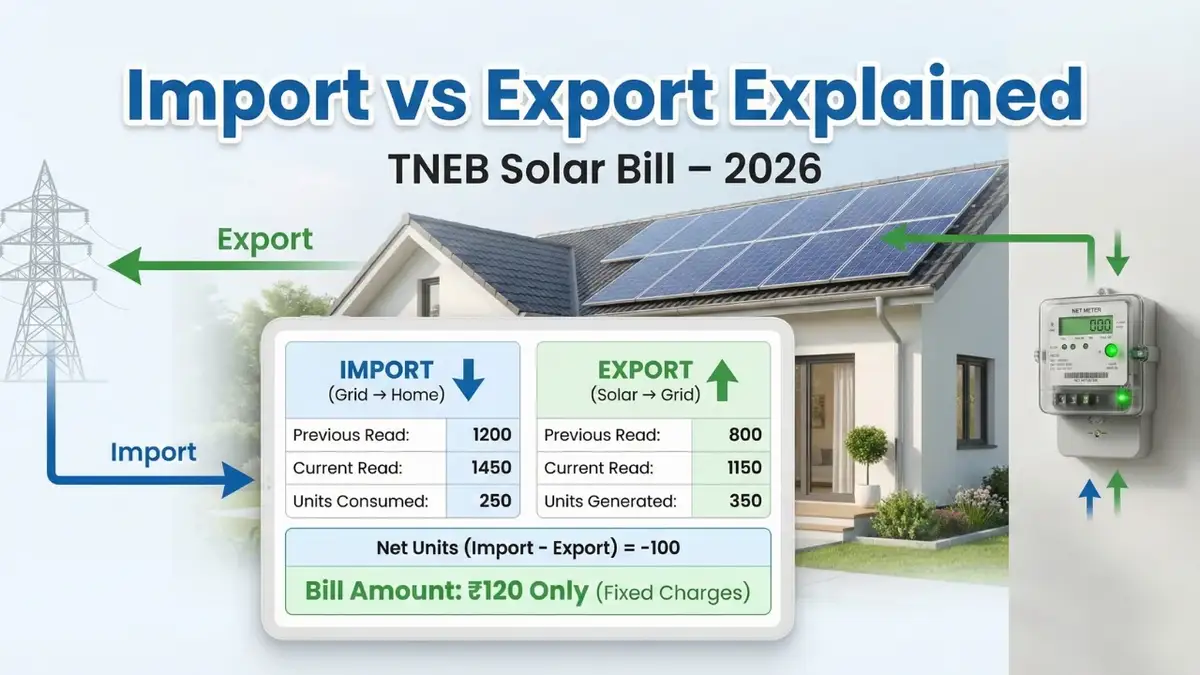
Congratulations! You installed solar. The green light is blinking. But then the first bi-monthly bill arrives, and it looks complicated. "Why did I get a bill of ₹120 when I made 500 units?" "Where are my banked units?" "What is C1, C2, C3?"
Here is a simple, non-technical guide to reading the TNEB Net Meter Bill in 2026.
1. The 3 Key Numbers
Your Solar Net Meter (Bi-Directional Meter) records two things separately. It creates a balance sheet of energy.
A. Import (What you took from TNEB)
This is the electricity you pulled from the grid wires.
- When: Mostly at night (6 PM to 6 AM) or during cloudy moments when your AC load exceeded solar generation.
- Example: You imported 400 Units over the 60-day billing cycle.
B. Export (What you gave to TNEB)
This is the Excess solar power you sent back to the grid.
- Clarification: This is NOT your total generation. If you generated 600 units and used 150 units instantly for your Fridge/Fan, the meter never sees that 150. It only sees the remaining 450 Units that crossed the wire to the pole.
C. Net (The Billable Amount)
Net = Import - Export.
- Calculation: 400 (Imp) - 450 (Exp) = -50 Units.
Calculate your Bill Savings Now
2. The "Banking" Concept
If your Net is Negative (-50 units):
- Bill For Energy: ₹0.
- Credit: The 50 extra units are "Banked" (Carried Forward) to your next bill cycle.
- Next Month: If you consume more in summer (say Net is +30), these 50 units will cover it, and you still have 20 left.
- Banking Period: In TN, credits are usually valid for 1 financial year. They do not get paid out in cash for domestic users; they just offset future bills.
If your Net is Positive (+200 units):
- Example: Imp 500 - Exp 300 = 200 Units.
- Bill Amount: You pay for 200 units only.
- The Saving Multiplier: Without solar, you would have paid for 500 units (Higher tariff slab of ₹6 or ₹8). With solar, you pay for 200 units (Lower tariff slab, maybe Free if <100 units). You save double because you drop down the slab tiers.
Solar Savings Calculator Tamil Nadu
Enter your EB bill to see the system size, savings and payback.
Enter amount between ₹2,000 and ₹30,000 • We specialize in 2 kW+ systems
Bill Not Matching Expectations?
Book a free bill analysis session. We'll review your consumption patterns and solar generation to optimize your savings.
3. Hidden Charges Explained
"Sir, my Net was zero, but I still paid ₹150. Why?" Even if you use 0 units from TNEB, you must pay certain mandatory charges:
- Fixed Charges (FC): Based on your sanctioned load.
- Example: ₹50 per kW. For a 3kW connection, FC = ₹150.
- Electricity Tax: A small percentage (Standard for all consumers).
- Network Charges: Usually applicable only for High Tension (HT) or Commercial consumers. For domestic homes, this is usually subsidized to zero or very low.
Note: If you see "Demand Charges" or "Penalty", contact your AE immediately. Domestic connections should not have these.
4. Reading the "Slots" (C1 to C5)
On some commercial Digital Meters, you see C1, C2, C3... These match the Time of Day (TOD) slots.
- C1 (Peak): 6 AM - 9 AM & 6 PM - 9 PM.
- C2 (Normal): Day time.
- C3 (Off Peak): Night time (10 PM - 5 AM).
For domestic users, TNEB usually sums them up. For factories, Solar is great because it wipes out the expensive C2 (Day Time) units.
5. Common Myths vs Reality
Myth: "All my solar power is sold to TNEB."
Fact: NO. Solar power flows to the path of least resistance. It goes to your Fridge first. Only if your Fridge is off does it go to TNEB. This is "Self Consumption" and it is the most profitable use of solar.
Myth: "Solar works during power cut with Net Meter."
Fact: NO. Standard Net Metering inverters shut down during a power cut for safety (Anti-Islanding). TNEB linemen working on the pole would die if your solar plant sent power back during a repair. (Use a Hybrid system if you need backup).
Summary: As long as your "Export" is higher than "Import" on average, you will receive a bill of just the Fixed Charges (approx ₹120 - ₹200). That is financial freedom.
Local Decision Notes
After solar commissioning, compare import, export, and net units every billing cycle. Do not judge performance from the payable amount alone because fixed charges and banking rules can confuse the picture. If generation looks lower than expected, check inverter app data, cleaning condition, shading, and meter readings together. A good installer should explain the first few bills so the homeowner understands whether the system is performing correctly.
Monthly Bill Review Habit
After each billing cycle, save a photo or PDF of the EB bill and compare it with inverter app generation. Track three numbers: grid import, solar export, and total solar generation. If import is high even during sunny months, your daytime usage may be low or your system may need checking. If generation drops suddenly, inspect cleaning, shade, inverter status, and meter readings before assuming the bill is wrong.
When to Call the Installer
Call your installer if export units suddenly drop, the inverter app shows errors, generation falls after normal cleaning, or the meter reading does not match expected behavior. Early checking prevents small issues from becoming months of lost savings.
Frequently Asked Questions
What are import and export units on my TNEB bill?
Why do I still pay a bill after installing solar?
What happens to extra units I export?
Related Articles
- TNEB Net Meter Process - How net metering works
- Solar ROI Calculator - Financial breakdown
- System Sizing Guide - Right size for zero bills
Get a Free Rooftop Assessment
Our engineers will visit your site, analyze shadow-free area, and provide a detailed solar report.
Book Free AssessmentTags
Ready to Switch to Solar?
Get a customized solar solution for your home. Save up to 90% on electricity bills!
- Free Site Visit
- Govt. Subsidy Support
- 25 Years Warranty