
Rooftop Solar for Industries & Commercial Buildings in TN
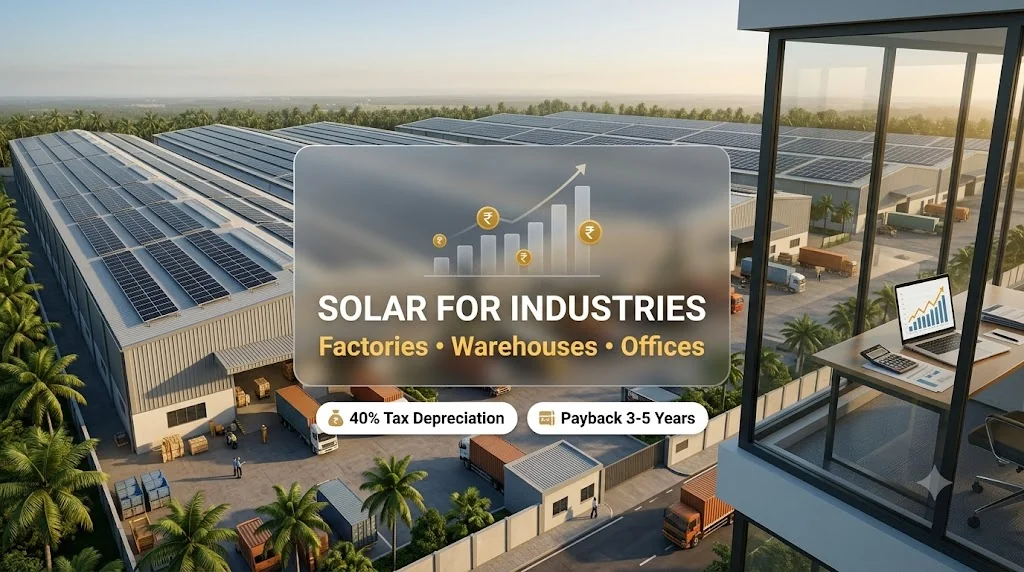
Short answer: rooftop solar is one of the best investments for factories, warehouses, hospitals, schools, offices and malls in Tamil Nadu, because they use most of their power in the daytime, exactly when solar produces. In 2026, systems of 20 kW and above typically cost about ₹40,000-55,000 per kW installed. Businesses get no PM Surya Ghar subsidy, but can claim 40% accelerated depreciation, and payback is often 3-5 years. You can buy the plant (CAPEX) or pay per unit with no upfront cost (OPEX).
Business in Cuddalore or Puducherry? See our commercial rooftop solar page and book a free site survey.
Market averages as of October 2026, not quotes. Tax and metering rules depend on your tariff and business structure; confirm with your auditor and the current TNERC order.
Commercial Solar at a Glance
| Building | Typical size | Why it fits |
|---|---|---|
| Small factory / workshop | 20 - 100 kW | Machines run in daytime shifts |
| Warehouse / cold storage | 50 - 300 kW | Large roof area, steady load |
| Hospital / clinic | 20 - 150 kW | High daytime AC and equipment load |
| School / college | 20 - 200 kW | Daytime use, big terraces |
| Office / IT unit | 20 - 100 kW | Working hours match solar hours |
| Hotel / mall | 50 - 300 kW | AC load all day |
Cost per kW (2026, Market Range)
| System size | Approx. cost per kW | Example total |
|---|---|---|
| 20 kW | ₹48,000 - ₹55,000 | ₹9.6 - 11 lakh |
| 50 kW | ₹44,000 - ₹50,000 | ₹22 - 25 lakh |
| 100 kW | ₹40,000 - ₹46,000 | ₹40 - 46 lakh |
| 250 kW+ | ₹38,000 - ₹44,000 | quoted per project |
Businesses that do not take PM Surya Ghar subsidy can use ALMM-listed non-DCR panels, which usually cost less per watt. See DCR vs non-DCR panels. Smaller shops: solar for shops and small businesses.
CAPEX vs OPEX: Buy or Pay Per Unit?
| CAPEX (you own it) | OPEX / PPA (developer owns it) | |
|---|---|---|
| Upfront cost | Full system cost | None |
| Savings | All bill savings are yours | You pay per unit, below grid rate |
| Tax benefit | 40% accelerated depreciation to you | Goes to the developer |
| Maintenance | Your responsibility (or AMC) | Developer's responsibility |
| Contract | None after purchase | Long-term agreement, often 15-25 years |
| Best for | Profitable businesses with cash or loans | Businesses that want zero investment |
Most small and mid-size businesses in Cuddalore district choose CAPEX because payback is short and the tax benefit is valuable. Large plants sometimes prefer OPEX to keep capital for production.
Tax Benefit: 40% Accelerated Depreciation
A solar plant owned by a tax-paying business can be depreciated at 40% per year on the written-down value. On a ₹20 lakh plant, the first-year depreciation is ₹8 lakh, which reduces taxable profit. The full worked example is in accelerated depreciation for solar. Always confirm with your chartered accountant.
Roof Types: RCC and Metal Sheet
| Roof | Mounting | Watch for |
|---|---|---|
| RCC terrace | Galvanized structure, often raised | Waterproofing at anchor points |
| Metal sheet (trapezoidal) | Rails clamped to seams or purlins | Sheet age, rust, load capacity |
| Asbestos sheet | Separate frame, no drilling into sheets | Safety; often needs a sub-structure |
| Ground (open land) | Ground-mounted structure | Land use, fencing, cleaning access |
Coastal industrial areas such as SIPCOT Cuddalore need hot-dip galvanized structures and stainless fasteners because of salt air: rust-proof solar for coastal sites.
Metering and TNEB Rules for Businesses
- Commercial and industrial rooftop systems connect through TNPDCL with a meter arrangement set by TNERC for your tariff category.
- Charges and settlement rules for non-domestic solar have been revised and debated over the years, so check the current TNERC order before investing.
- Larger systems need a three-phase connection and suitable sanctioned load or contract demand.
More: Tamil Nadu solar net metering policy.
Payback: What Drives It
- Daytime self-consumption. The more solar units you use directly during working hours, the faster the payback.
- Your tariff. Higher commercial and industrial tariffs make each solar unit more valuable.
- Working days. A 6-day factory uses more solar than a 5-day office.
- Tax benefit. Depreciation shortens payback for profitable businesses.
- Maintenance. Regular cleaning keeps output high, especially near dust and industry: solar maintenance guide.
Typical result: about 3-5 years for businesses with strong daytime use.
Project Steps for a Business
- Share 12 months of EB bills and load details.
- Site survey: roof strength, shade, space, cable routes, transformer.
- Design and proposal: size, layout, CAPEX or OPEX options, payback.
- TNPDCL approval and any load or meter changes.
- Installation (days to a few weeks, depending on size).
- Inspection, metering and commissioning.
- Monitoring and AMC to keep generation high.
Hybrid or Battery for Critical Loads?
Most businesses choose on-grid for the best return. For critical loads (billing systems, CCTV, lab equipment, cold storage controls), a small UPS or a hybrid inverter with batteries for only those loads costs far less than backing up the whole plant. See solar with battery backup price.
Frequently Asked Questions
How much does commercial rooftop solar cost in Tamil Nadu?
Do industries get PM Surya Ghar subsidy?
What is the payback period for commercial solar?
Can solar panels be installed on a metal sheet roof?
What is the difference between CAPEX and OPEX solar?
Free Assessment for Your Business
Send your last 12 months of EB bills on WhatsApp and we will estimate system size, cost per kW and payback including the tax benefit, then survey your site for free. Serving Cuddalore including SIPCOT, Puducherry, Neyveli and nearby towns. Call or WhatsApp +91 7904369094.
Get a Free Rooftop Assessment
Our engineers will visit your site, analyze shadow-free area, and provide a detailed solar report.
Book Free AssessmentTags
Ready to Switch to Solar?
Get a customized solar solution for your home. Save up to 90% on electricity bills!
- Free Site Visit
- Govt. Subsidy Support
- 25 Years Warranty