
Solar Battery vs Normal Inverter Battery: Which to Buy?
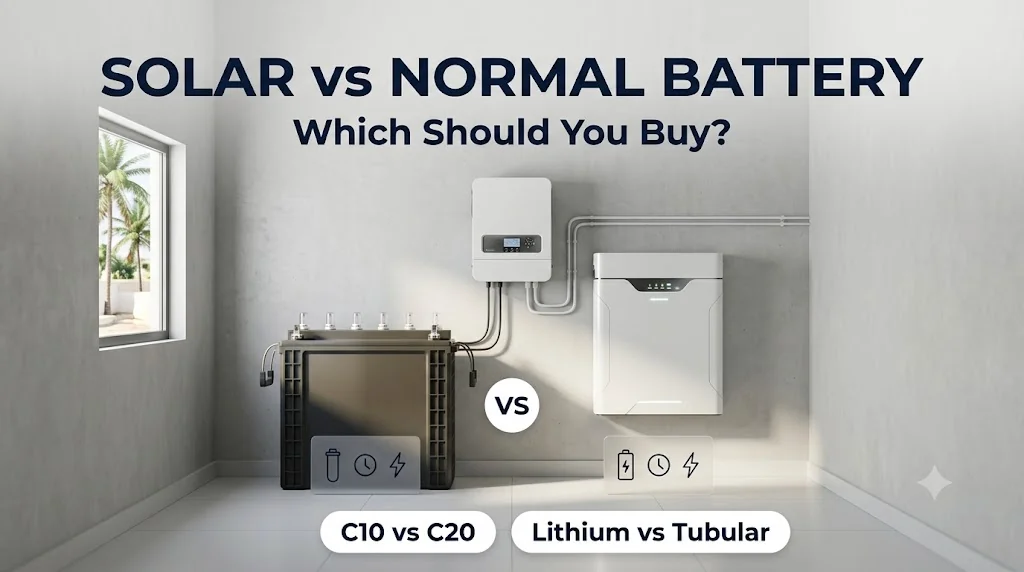
Short answer: a solar battery is designed for daily charging from solar and deep, daily discharge, and is usually rated at C10. A normal inverter battery is designed for occasional power cuts with grid charging, usually rated at C20. A normal battery can work with solar, but it wears out faster when cycled every day. For a hybrid solar system, choose a solar tubular battery on a budget, or lithium (LFP) for the longest life and no maintenance. For a plain on-grid system, you need no battery at all.
Solar Battery vs Normal Battery at a Glance
| Normal inverter battery | Solar tubular battery | Lithium (LFP) solar battery | |
|---|---|---|---|
| Designed for | Occasional power cuts | Daily solar cycling | Daily solar cycling |
| Typical rating | C20 | C10 | Rated in kWh / cycles |
| Charging | Grid, steady | Solar, variable current | Solar, fast charging |
| Daily use life | Short | about 4 - 6 years | about 8 - 10+ years |
| Usable capacity | about 50% | about 50% | about 80 - 90% |
| Maintenance | Water top-up | Water top-up | None |
| Price | Lowest | Medium | Highest upfront |
Life depends on depth of discharge, temperature and charging. Figures are typical, not guaranteed.
C10 vs C20: What the Label Means
Battery capacity (Ah) is quoted at a certain discharge rate:
- C20 = capacity measured over a slow 20-hour discharge (typical of normal inverter batteries).
- C10 = capacity measured over a faster 10-hour discharge (typical of solar batteries).
A 150Ah C10 battery delivers its rated capacity at a faster discharge than a 150Ah C20 battery, so the C10 battery suits solar loads better. Solar batteries also accept the changing charge current from panels through the day, which is harder on standard batteries.
Can You Use Your Existing Inverter Battery With Solar?
| Your situation | Advice |
|---|---|
| You already have a home UPS and want on-grid solar | Keep both separate. On-grid solar needs no battery; your UPS covers cuts as before. |
| You want a small solar charger for your UPS battery | Possible with a solar charge controller, but expect shorter battery life with daily cycling |
| You want a proper hybrid system for backup | Use solar tubular or lithium batteries matched to the hybrid inverter |
Most Tamil Nadu homes get the best value from on-grid solar plus their existing UPS, and add a hybrid later only if cuts are frequent. Compare: on-grid vs hybrid solar.
Price Comparison (2026 Market Range)
| Battery | Approx. price |
|---|---|
| 150Ah normal inverter battery | ₹11,000 - ₹15,000 |
| 150Ah solar tubular (C10) | ₹13,000 - ₹18,000 |
| 200Ah solar tubular (C10) | ₹17,000 - ₹23,000 |
| 5kWh lithium (LFP) pack | ₹1.1 - 1.6 lakh |
Over 10 years, a lithium battery often costs less per usable unit than replacing tubular batteries twice, if you cycle it every day. Full system prices: solar with battery backup price.
How to Choose the Right Battery
- Decide if you need backup at all. Short, rare cuts: skip the battery and go on-grid.
- List your essential loads (fans, lights, fridge, Wi-Fi) and the hours of backup you want.
- Size in kWh: for 600 W of essential load and 6 hours, about 3.6 kWh usable.
- Match the inverter: the battery must be on the hybrid inverter's approved list.
- Check warranty in years and cycles, and who services it locally.
- Plan the location: shaded, ventilated, above flood level.
Exide makes both solar batteries and solar panels; see our Exide solar panel and battery review.
Battery Care in Tamil Nadu Heat
- Keep batteries indoors and out of direct sun; heat shortens battery life.
- Tubular batteries: check distilled water every 2-3 months and keep terminals clean.
- Lithium batteries: no water, but keep them within the temperature range on the datasheet.
- During long monsoon cloudy spells, let the grid top up a hybrid battery so it does not sit empty.
Common Mistakes With Solar Batteries
- Buying a battery for an on-grid system. On-grid inverters do not use batteries; the money is wasted.
- Oversizing the battery. Size for essential loads and real cut hours, not the whole house.
- Mixing old and new batteries in one bank, which shortens the life of the new ones.
- Keeping batteries in a hot, closed room, which cuts their life sharply.
Frequently Asked Questions
What is the difference between a solar battery and a normal battery?
Can I use a normal inverter battery with solar panels?
What does C10 and C20 mean on a battery?
Which lasts longer, a solar tubular or lithium battery?
Do I need a battery for an on-grid solar system?
How many batteries does a 3kW hybrid system need?
Not Sure You Need a Battery?
Tell us how often your power goes off and what you need running. We will tell you honestly whether on-grid, on-grid plus your existing UPS, or a hybrid system is the right choice. Official Exide partner. Call or WhatsApp +91 7904369094.
Get a Free Rooftop Assessment
Our engineers will visit your site, analyze shadow-free area, and provide a detailed solar report.
Book Free AssessmentTags
Ready to Switch to Solar?
Get a customized solar solution for your home. Save up to 90% on electricity bills!
- Free Site Visit
- Govt. Subsidy Support
- 25 Years Warranty