
Solar Panels in Rain & Cyclones: Cuddalore Monsoon Guide
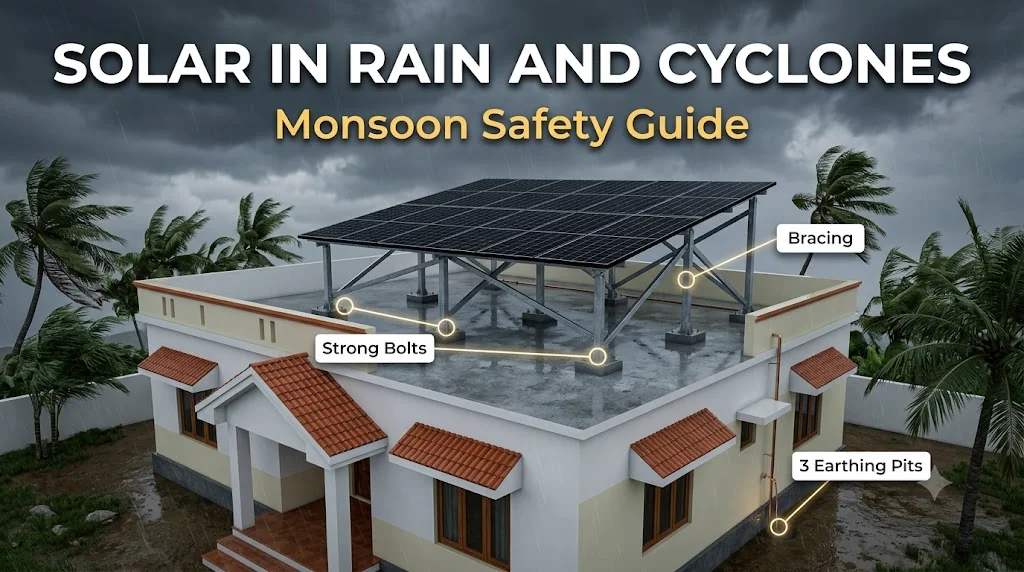
Short answer: yes, solar panels work in the rainy season, just at lower output: roughly 30-60% of a sunny day depending on cloud cover. And yes, a well-built system survives cyclones. In coastal Cuddalore and Puducherry the weak point is almost never the panel; it is the structure, the anchoring and the earthing. Here is what every homeowner should know before the northeast monsoon.
How Much Do Panels Produce in the Monsoon?
Tamil Nadu gets nearly half its yearly rain in the northeast monsoon (October to December), so this is the lowest-output season.
| Weather | Output vs a clear day | 3kW system, units per day |
|---|---|---|
| Clear sunny day | 100% | 13 - 15 |
| Light clouds | 70 - 85% | 10 - 12 |
| Heavy overcast | 30 - 60% | 5 - 8 |
| Continuous heavy rain | 10 - 25% | 2 - 4 |
Over a whole month even the monsoon averages 95-115 units per kW, because there are always some sunny hours between rains. Summer then produces 150+ units per kW per month. With a net meter, your extra summer units are credited, so the yearly balance works out. Season-by-season numbers: 1kW units per day and 5kW units per day.
Cyclones: What Actually Fails (and How to Prevent It)
Cuddalore and Puducherry have seen severe cyclones, from Thane (2011) to Fengal (2024). When rooftop systems fail in storms, the cause is usually one of these:
| What fails | Why | How we prevent it |
|---|---|---|
| Structure lifts or bends | Thin or poorly anchored frames; wind gets under the panels | Hot-dip galvanized steel structure designed for coastal wind loads as per IS 875 (Part 3), anchored into the roof slab |
| Panels fly off | Loose or under-sized clamps | Correct clamps on every panel, bolts torqued and marked, checked before the monsoon |
| Rust weakens joints | Salt air on cheap pre-galvanized or painted steel | Hot-dip galvanizing (thicker zinc coat), stainless fasteners |
| Water damage to inverter | Inverter or DC box placed where rain or floodwater reaches | Inverter indoors or under cover, above flood level, IP65-rated boxes |
The panel glass itself is tested for heavy loads (international panel standards include static load tests far above normal wind pressure). A panel rarely breaks unless the structure under it moves.
Read more: best solar structure for coastal Tamil Nadu and rust-proof solar for Cuddalore and Pondicherry.
Lightning and Thunderstorms
Monsoon thunderstorms are a bigger daily risk than cyclones. A good system has:
- Three separate earthing pits: one for the AC side, one for the DC side and one for the lightning arrester (LA). Mixing them can send surge current back into your house wiring.
- A lightning arrester mounted above the highest panel.
- Surge protection devices (SPDs) in the DC and AC distribution boxes.
Why we insist on this: solar earthing guide: why you need 3 separate pits.
Pre-Monsoon Checklist for Solar Owners
Do these (or ask your installer to) before October:
- Bolts and clamps: every panel clamp tight, no rust at joints.
- Structure base: anchors firm, no cracks in the roof around the legs.
- Cables: no cracked insulation, cables clipped (not flapping), conduits sealed. Poor DC cables are a fire risk: DC cable quality guide.
- Earthing pits: water the pits and check connections are not corroded.
- Inverter location: protected from rain and above any flood level.
- Drainage: terrace drains clear so water does not pool under the structure.
- Clean once: wash off salt and dust with plain water (no detergent, no high-pressure jet).
During and After a Cyclone
- Before landfall: if your area is under a cyclone warning or flooding is expected near the inverter, switch off the AC and DC isolators as your installer has shown you.
- During the storm: stay indoors. Never go to the roof.
- After the storm: look from a safe place. If panels are cracked, cables are hanging or the structure has moved, do not touch anything; call your installer.
- Insurance: many home insurance policies can cover rooftop solar against storm damage. Keep your invoice and installation photos.
Does Rain Cause Short Circuits? (IP Ratings Explained)
A properly installed system is built to sit in the rain for 25 years. What keeps water out:
| Part | Rating to look for | Meaning |
|---|---|---|
| Panel junction box | IP67 / IP68 | Dust-tight, survives temporary immersion |
| DC connectors (MC4 type) | IP67 or better, same brand both halves | Mismatched connectors leak and corrode |
| DC and AC distribution boxes | IP65 | Protected against rain jets |
| Inverter | IP65 (outdoor) or indoor placement | Rain-safe |
Problems come from mismatched connectors, open cable entries and boxes mounted facing the rain, not from rain itself. This is workmanship, which is why the installer matters more than the brand.
6 Questions to Ask Before You Buy Solar This Monsoon
- What structure do you use: hot-dip galvanized or pre-galvanized? What is the zinc thickness?
- How is the structure anchored to my roof, and will my roof waterproofing stay intact?
- How many earthing pits, and is there a lightning arrester?
- Where will the inverter be placed, and is it protected from rain and flooding?
- Are the DC connectors the same brand on both sides, and what is their IP rating?
- Do you offer a pre-monsoon check after installation?
If an installer gets vague on any of these, look elsewhere. See 7 solar scam warnings.
Is Monsoon a Bad Time to Install Solar?
No. Installation takes only 1-3 days and can be planned between rain spells. Starting now also means your system is ready for the high-output summer, and you stay ahead of the PM Surya Ghar deadline (31 March 2027) for the ₹1 lakh subsidy. Read: PM Surya Ghar last date 2027.
Frequently Asked Questions
Do solar panels work in the rainy season?
Can solar panels survive a cyclone?
Is it safe to have solar panels during thunderstorms?
Should I switch off my solar system during a cyclone?
Does rain clean solar panels?
Book a Cyclone-Ready Installation or Pre-Monsoon Check
Surya's Solar is based in Kondur, Cuddalore, and designs every system for coastal wind, salt and lightning. Call or WhatsApp +91 7904369094 (open all 7 days). See our solar installation in Cuddalore page.
Get a Free Rooftop Assessment
Our engineers will visit your site, analyze shadow-free area, and provide a detailed solar report.
Book Free AssessmentTags
Ready to Switch to Solar?
Get a customized solar solution for your home. Save up to 90% on electricity bills!
- Free Site Visit
- Govt. Subsidy Support
- 25 Years Warranty