
Solar DC Cable Guide: Why Cable Quality Prevents Fires
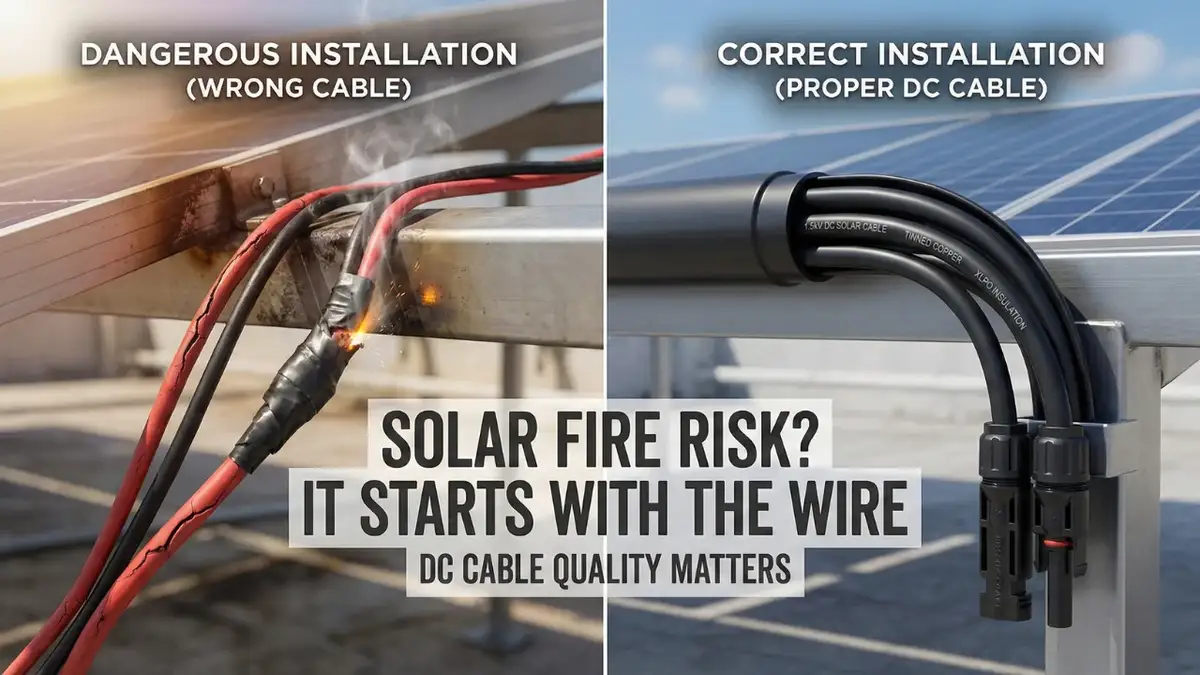
Solar Panels generate DC (Direct Current). The grid in your house is AC (Alternating Current). You cannot use normal house wire (flexible PVC wire) for solar panels.
If an installer uses normal "Red/Black" AC wire on your roof to save ₹2,000, he is planting a fire hazard. The cost difference between a cheap wire and a proper DC cable is negligible (approx ₹2,500 for a mix home), but the safety difference is life or death.
This guide explains the engineering behind DC Solar Cables and why we at Surya's Solar enforce a strict quality code.
1. The Enemy: UV Radiation (The Sun Killer)
Normal PVC insulation (used in house wiring brands like Finolex or Anchor) is fantastic for indoor use. It is designed to sit inside a PVC conduit or concealed in a wall. But Solar Wire sits on the roof, exposed to direct sunlight for 10 hours a day, 365 days a year.
What happens to PVC on the roof?
- Months 1-12: It looks fine.
- Months 12-36: The UV rays break the chemical bonds in the PVC plastic. It loses flexibility and becomes brittle like a dry biscuit.
- Year 4: Small cracks appear.
- Year 5: The first rain enters the crack. The water touches the live DC conductor.
- Result: DC Arc Fault. A spark jumps, reaching 3000°C. The dry plastic catches fire.
The Solution: XLPO Insulation
Specialized Solar DC Cable uses XLPO (Cross-Linked Polyolefin) insulation.
- Electron Beam Cured: The plastic is bombarded with electrons during manufacturing to make it tough.
- UV Resistant: It is tested to withstand UV radiation for 25 years.
- Halogen Free: In case of a fire, it does not release black toxic smoke (unlike PVC).
- Durability: You can leave it in the sun, rain, or mud-it will not crack.
2. The Conductor: Tinned Copper vs. Bare Copper
Cut open a Solar Cable from premium brands like Polycab, Siechem, or Apar. The copper strands look Silver, not Red.
"Is it Aluminium?" No. It is "Tinned Copper" (Pure Electrolytic Copper coated with a thin layer of Tin).
Why Tinning?
- Oxidation: Bare copper reacts with oxygen. Over time, it turns green (Copper Oxide). This green layer is an insulator. It increases resistance at the joints. High Resistance = Heat = Fire.
- Galvanic Corrosion: In Cuddalore's coastal air (salty humidity), bare copper corrodes 5x faster. Tin is non-reactive. It creates a shield.
- Standard: As per EN 50618 (Global Solar Cable Standard), solar cable MUST be tinned copper.
If your installer brings a "Red" copper wire for the DC side, stop the work immediately.
3. Voltage Drop Calculation: 4 sq.mm vs 6 sq.mm
We don't pick wire size by guessing. We calculate the "Voltage Drop". Solar energy is precious. We don't want to lose it heating up the wire.
The Physics: Resistance ($R$) is proportional to Length ($L$) and inversely proportional to Area ($A$). $$ R \propto \frac{L}{A} $$
- Scenario A (Standard): 10 Panels. Inverter is on the top floor (near panels). Wire length = 20 meters.
- Choice: 4 sq.mm is perfect. Loss is < 1%.
- Scenario B (Commercial/High Rise): Panels on 4th floor. Inverter on Ground floor. Wire length = 60 meters.
- Choice: If we use 4 sq.mm, we might lose 3% of power. We MUST upgrade to 6 sq.mm or even 10 sq.mm.
Surya's Rule: We design for < 1.5% Voltage Drop. If the distance > 40 meters, we automatically upgrade to 6 sq.mm wire at no extra cost to you.
4. The Critical Joint: MC4 Connectors
The wire itself rarely fails. The Joint is where 90% of fires start.
The "Tape" Mistake: In house wiring, electricians twist wires together and wrap black insulation tape. In Solar, Insulation Tape is Illegal.
- The glue in the tape melts in 60°C roof heat.
- The tape unwraps.
- The joint touches the metal structure.
- BOOM.
The Correct Way: MC4 Connectors We use IP68 Standard MC4 Connectors for every single connection.
- Mechanism: They "Click" lock. A human cannot pull them apart without a tool.
- Waterproof: You can dip them in a bucket of water, and they won't leak current.
- Current Rating: Rated for 30 Amps (Solar panels produce ~13 Amps).
Warning: Many installers use "Compatible" fake MC4s (China copies). We use original Staubli or Polycab connectors. A loose contact in a fake connector is a ticking time bomb.
5. Cable Management (Conduits)
Even the best wire needs protection. We never leave cables "hanging" loose like clotheslines.
- UV PVC Conduit: All wires run inside rigid, heavy-duty conduits.
- Cable Trays: For commercial jobs, we use perforated metal cable trays.
- Cable Ties: We use UV-Nylon (Black) cable ties, not the cheap White ones (which break in 2 months).
Want a Quality Inspection?
Our engineers can inspect your existing installation for cable quality and fire safety compliance. Get a detailed audit report.
6. How to Spot a "Fake" or "Sub-Standard" Installation
When you inspect a site or read a quote, look for these Red Flags:
| Feature | Yes Good Standard | No Dangerous Cost-Cutting |
|---|---|---|
| Cable Markings | "Solar Cable 1.5kV DC" printed on wire | "1100V PVC" or No printing |
| Conductor Color | Silver (Tinned Copper) | Red (Bare Copper) |
| Joints | MC4 Connectors Only | Black Tape / Wire Nuts |
| Conduit | Rigid PVC Pipes clamped to wall | Flexible hose hanging loose |
| Brand | Polycab / Siechem / Apar / Lapp | Finolex (AC Type) / Unbranded |
7. Conclusion: The Veins of your System
Think of Solar Panels as the Heart (pumping energy). Think of Cables as the Veins (carrying the energy). If the veins are blocked or weak, the heart fails.
Using cheap wire saves maybe ₹3,000 on a ₹2 Lakh project (1.5% savings). But it risks the entire 100% investment.
At Surya's Solar, we sleep well at night because we know your cables are safe.
Frequently Asked Questions
Can ordinary house wire be used for solar panels?
What size DC cable is used for a 3kW system?
Why are MC4 connectors important?
Related Articles
- Earthing Safety Guide - Complete safety checklist
- Shadow Analysis - Optimize wire routing
- Maintenance Tips - Cable inspection schedule
Get a Free Rooftop Assessment
Our engineers will visit your site, analyze shadow-free area, and provide a detailed solar report.
Book Free AssessmentTags
Ready to Switch to Solar?
Get a customized solar solution for your home. Save up to 90% on electricity bills!
- Free Site Visit
- Govt. Subsidy Support
- 25 Years Warranty