
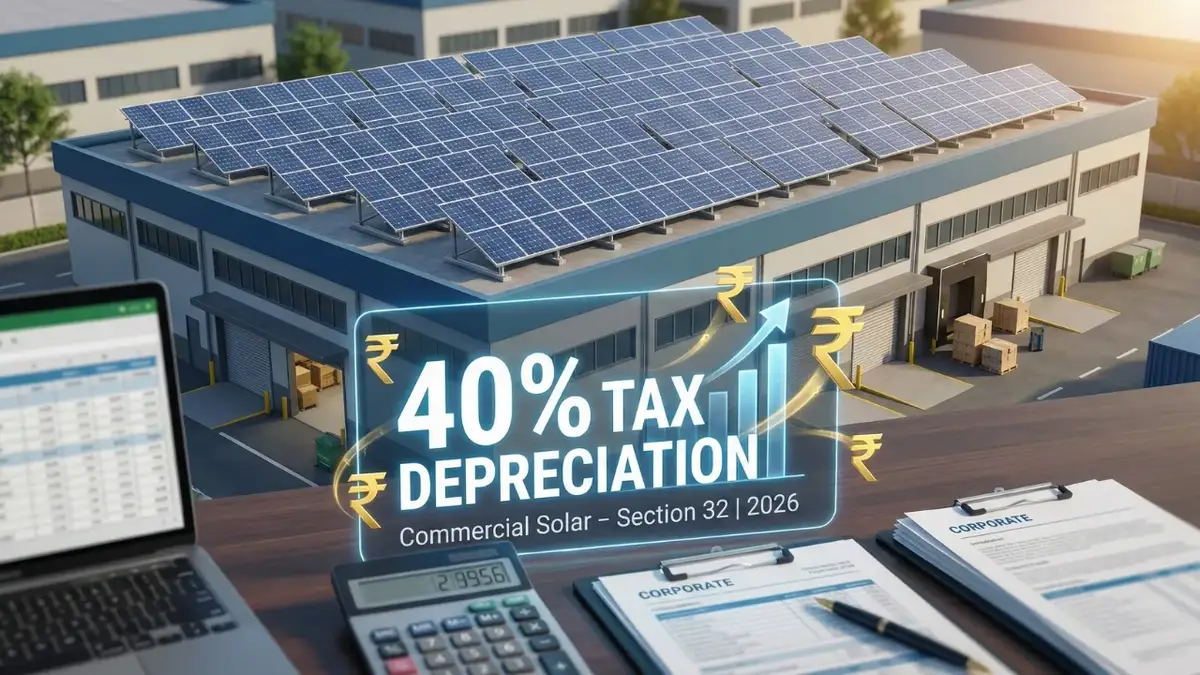
Solar Accelerated Depreciation: 40% Tax Benefit Explained
If you run a profitable business-whether it’s a Textile Mill in Coimbatore, a Hotel in Puducherry, or a Cashew Factory in Panruti-you face two major drains on your cash flow:
- Electricity Bills: Rising at 5% per year.
- Corporate Tax: Taking away 25% - 30% of your hard-earned profits.
Planning solar for your business? See commercial rooftop solar in Cuddalore and Puducherry.
In 2026, Commercial Solar is the unique financial instrument that solves both problems simultaneously. It is one of the few assets that pays you back in two currencies: Energy and Tax Shields.
This guide explains specifically how Section 32 of the Income Tax Act works for business owners in Tamil Nadu.
1. What is Accelerated Depreciation (AD)?
In accounting, "Depreciation" is the reduction in the value of an asset over time due to wear and tear. You can deduct this loss from your profit before paying tax.
- Normal Machinery: Depreciates at 15% per year (Written Down Value).
- Solar Power Plants: Categorized as "Renewable Energy Devices", they enjoy 40% Accelerated Depreciation per year.
Why does this matter? It allows you to book a massive "Loss" (Expense) in the very first year of purchase, significantly lowering your Taxable Income.
Solar Savings Calculator Tamil Nadu
Enter your EB bill to see the system size, savings and payback.
Enter amount between ₹2,000 and ₹30,000 • We specialize in 2 kW+ systems
2. The ROI Calculation: How Efficiency Meets Tax Savings
Let's simulate a standard business case for a Cuddalore factory.
The Scenario:
- System Size: 20kW On-Grid Solar Plant.
- Total Invetsment: ₹10,00,000 (10 Lakhs).
- Corporate Tax Rate: 30% (including surcharge/cess).
- Electricity Tariff: ₹10/unit.
The Tax Shield Table (Section 32)
| Year | Opening Value (WDV) | Depreciation Rate | Depreciation Expense (Booked in P&L) | Cash Saved (30% Tax Shield) |
|---|---|---|---|---|
| Year 1 | ₹10,00,000 | 40% | ₹4,00,000 | ₹1,20,000 |
| Year 2 | ₹6,00,000 | 40% | ₹2,40,000 | ₹72,000 |
| Year 3 | ₹3,60,000 | 40% | ₹1,44,000 | ₹43,200 |
| Year 4 | ₹2,16,000 | 40% | ₹86,400 | ₹25,920 |
| TOTAL | ~ ₹2.6 Lakhs |
Verdict: You recover 26% of your project cost purely through tax savings in 4 years.
The Energy Savings Table
- Generation: A 20kW plant generates approx 30,000 Units per year in Cuddalore.
- Bill Impact: 30,000 x ₹10 = ₹3.0 Lakhs Saved per Year.
Total ROI Summary (Payback Period)
- Year 1 Inflow: ₹3.0L (Energy) + ₹1.2L (Tax) = ₹4.2 Lakhs.
- Year 2 Inflow: ₹3.0L (Energy) + ₹0.72L (Tax) = ₹3.72 Lakhs.
- Year 3 Inflow: ₹3.0L (Energy) + ₹0.43L (Tax) = ₹3.43 Lakhs.
Cumulative Inflow by Year 3: ₹11.35 Lakhs. Initial Investment: ₹10 Lakhs. Payback Period: Less than 3 Years. After Year 3, the energy is effectively free for the next 22 years.
3. GST Input Tax Credit (ITC)
Apart from Income Tax, you also save on GST.
- Solar Components typically attract 12% to 18% GST.
- If you are a GST-registered business, you can claim the Input Tax Credit (ITC) on the solar plant purchase against your output GST liability.
- Benefit: This effectively reduces the "Real Cost" of the system by another 12-18%.
Consult our Commercial Solar Team
4. Worked Example: A School
Illustrative scenario, not a specific customer.
Profile: A school with about 800 students. High daytime load (Fans, Smartboards, ACs in Staff Room). Challenge: Monthly Bill was ₹45,000. Solution: 25kW Solar On-Grid System.
Expected results:
- Bill: Most of the daytime units covered by solar; the exact saving depends on the tariff and holidays.
- Tax: If the trust or business pays tax, 40% depreciation can offset profits (confirm with your auditor).
- Educational Value: The plant can double as a "Physics Lab" to teach students about renewable energy.
Need Tax Planning Support?
Our commercial solar experts will coordinate with your CA to maximize your depreciation benefits and ROI.
5. Comparison: Solar vs. Fixed Deposit (FD)
Many business owners ask: "Why shouldn't I just put ₹10 Lakhs in an FD?"
| Feature | Fixed Deposit (Bank) | Solar Power Plant |
|---|---|---|
| ROI | 7% per year | 30% - 40% per year |
| Tax Impact | Interest is Taxable (You pay tax) | Depreciation is Deductible (You save tax) |
| Risk | Zero Risk | Low Risk (Technology is proven) |
| Inflation | Inflation eats your returns | Hedged against Electricity Inflation |
| Asset Life | Liquid Cash | 25 Year Asset |
Conclusion: Solar beats FD by a margin of 4X.
6. Filing Checklist for Your Chartered Accountant (CA)
To ensure your claim is not rejected by the IT Department, maintain this "Audit File":
Original Tax Invoice: Must show the GSTIN of buyer and seller. Description should clearly say "Solar Power Generating System".
Commissioning Certificate: Or a "Work Completion Report" signed by the installer.
Connectivity Proof: The Safety Certificate from the Electrical Inspectorate (CEIG) or the Net Meter installation report from TNEB.
September 30th Rule:
- If the asset is "Put to Use" before Sept 30, you get 100% of the depreciation (40%).
- If installed after Sept 30, you get only 50% (20%) in that financial year. (Pro Tip: Installation in March is bad for tax planning!).
Photographs: Geo-tagged photos of the installed plant with the date.
7. Next Steps
If you are paying more than ₹20,000/month in electricity bills, you are losing money every day you wait. Shift your expense from "Revenue Expenditure" (paying bills) to "Capital Expenditure" (building an asset).
Don't pay TNEB. Don't pay Tax. Pay yourself.
Local Decision Notes
Commercial solar decisions should be reviewed with both the installer and the accountant. The engineering team should size the plant around actual daytime load, while the accountant confirms depreciation, GST treatment, and documentation. A factory, office, school, or shop can get strong value from solar when working hours overlap with generation hours. Keep invoices, commissioning documents, and asset records clean from day one because tax benefits depend on documentation as much as installation.
Planning a commercial plant? Costs per kW and CAPEX vs OPEX: rooftop solar for industries.
Frequently Asked Questions
Can a proprietorship or partnership claim accelerated depreciation?
Do businesses get PM Surya Ghar subsidy?
What size solar system suits a small shop?
Can a business use non-DCR panels?
Related Articles
- Solar Financing Options - Business loan solutions
- ROI Analysis - Complete financial breakdown
- TNEB Net Meter - Commercial liaisoning process
Get a Free Rooftop Assessment
Our engineers will visit your site, analyze shadow-free area, and provide a detailed solar report.
Book Free AssessmentTags
Ready to Switch to Solar?
Get a customized solar solution for your home. Save up to 90% on electricity bills!
- Free Site Visit
- Govt. Subsidy Support
- 25 Years Warranty