
Solar for Apartments in Tamil Nadu: RWA Subsidy Guide 2026
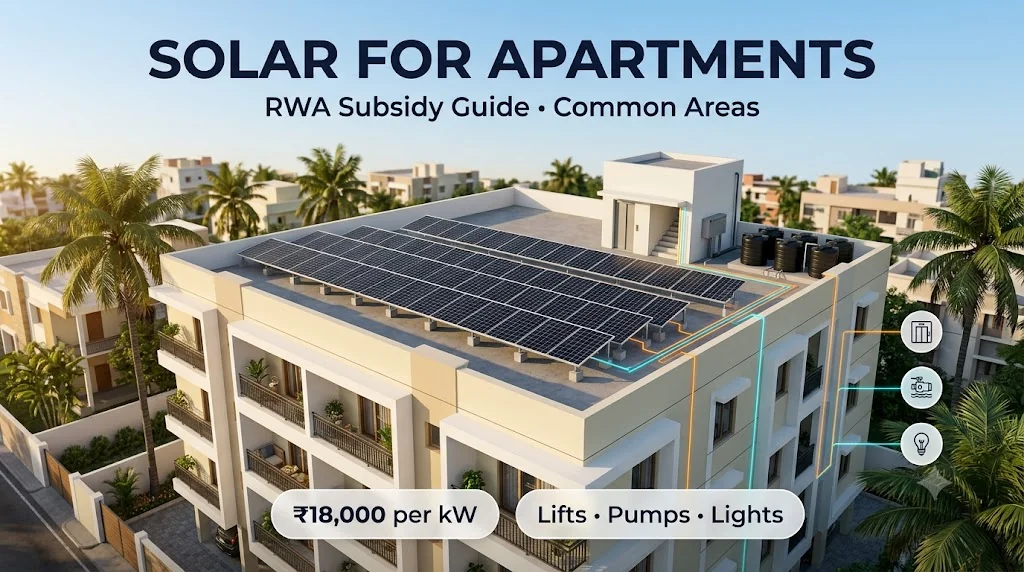
Short answer: yes, apartments in Tamil Nadu can go solar with a subsidy. Under PM Surya Ghar, a Resident Welfare Association (RWA) or Group Housing Society (GHS) gets ₹18,000 per kW for a rooftop system that runs common facilities (lifts, water pumps, corridor and parking lights, EV charging). The subsidy covers up to 500 kW, calculated at 3 kW per house. Individual flats usually cannot install their own system unless they have an exclusive roof and their own connection.
For your RWA: estimate the subsidy and book a free terrace survey on our apartment solar page.
Rules as reported in the PM Surya Ghar guidelines and consumer manuals, as of October 2026. We confirm the latest rules on the official portal before your association applies.
Apartment Solar Subsidy at a Glance
| Point | RWA / GHS (common facilities) |
|---|---|
| Subsidy rate | ₹18,000 per kW |
| Maximum capacity | 500 kW |
| Capacity rule | Lower of (houses x 3 kW) or plant size |
| Includes | Lifts, pumps, common lights, EV charging, security, gym |
| Applicant | The registered RWA / society |
| Connection | Common-area EB connection only |
| Panels | DCR, installed by a registered vendor |
Important: if some residents already installed their own rooftop systems under the scheme, that capacity is counted inside the same cap.
How Much Subsidy Can Your Apartment Get? (Examples)
| Apartment | Plant size | Eligible capacity | Subsidy |
|---|---|---|---|
| 12 flats | 10 kW | 10 kW (12 x 3 = 36 kW limit) | ₹1,80,000 |
| 24 flats | 20 kW | 20 kW | ₹3,60,000 |
| 8 flats | 30 kW | 24 kW (8 x 3 kW) | ₹4,32,000 |
| 60 flats | 50 kW | 50 kW | ₹9,00,000 |
The formula is simple: subsidy = ₹18,000 x lower of (flats x 3 kW, plant kW), with a 500 kW ceiling.
What Should the Apartment System Power?
Common-area loads are ideal for solar because most of them run in the daytime:
| Common load | Why solar fits |
|---|---|
| Water pumps (sump to overhead tank) | Can be scheduled for daytime solar hours |
| Lifts | Run all day; a big share of the common bill |
| Corridor, staircase and parking lights | Covered through net metering credit |
| Security cabin, gate motors, CCTV | Small, steady daytime load |
| EV chargers in parking | Included in the scheme's common facilities |
A system of about 1 kW for every 4 units of daily common-area use is a good starting estimate. We size it from the last 12 months of common EB bills.
Step by Step: How an RWA Goes Solar
- Collect 12 months of common EB bills and the terrace layout.
- Free site survey: we check shade-free terrace area, water tanks, structure and wind exposure. Roughly 80-100 sq ft per kW is needed; see how much roof space solar needs.
- Association meeting: approve the plan and budget, and authorise the secretary or treasurer to apply. Keep the minutes.
- Register on the PM Surya Ghar portal as an RWA/GHS with the common-area consumer number.
- TNEB feasibility approval, then installation by the registered vendor (usually 3-7 days for 10-30 kW).
- Inspection and net meter on the common connection.
- Subsidy credit to the association's bank account after commissioning.
The whole process typically takes 6-10 weeks, the same as homes. See solar installation timeline.
Can I Install Solar for My Own Flat?
In most apartments, no, because:
- The terrace is common property, so every owner has a share in it.
- Each flat's meter is in the meter room, often far from the terrace, so wiring separate systems is messy.
- Shade from water tanks and lift rooms limits space.
It can work when your flat has an exclusive terrace (top-floor duplex, row house), your own domestic connection, and written NOC from the association. Then you apply as an individual home and can get the normal home subsidy; check yours with the subsidy eligibility checker.
Common Objections in Association Meetings (and Answers)
| Objection | Answer |
|---|---|
| "It will damage the terrace waterproofing" | Raised structures use anchor bolts or ballast designs with proper sealing; the terrace stays usable underneath |
| "Who maintains it?" | Monthly cleaning by the housekeeping staff, yearly check by the installer; see solar maintenance guide |
| "What about cyclones?" | Coastal-grade, hot-dip galvanized structures designed for wind load; see monsoon guide |
| "We don't have the money upfront" | Collect through a one-time contribution or use the maintenance fund; the bill saving pays it back, often in 4-6 years |
Savings Example: 24-Flat Apartment
- Common-area use: about 80 units a day (lifts, pumps, lights).
- A 20 kW system makes about 80-100 units a day in Tamil Nadu.
- Subsidy: ₹3,60,000 (20 kW x ₹18,000).
- Net cost after subsidy is shared by 24 flats, and the lower common bill reduces monthly maintenance for everyone.
The exact saving depends on the common connection's tariff category; we calculate it from your actual bills.
Frequently Asked Questions
Can apartments get PM Surya Ghar solar subsidy?
How much subsidy can our apartment get?
Can I install solar on the terrace for my own flat?
Does the ₹22,000 Tamil Nadu top-up apply to apartments?
How much does solar save for an apartment?
Talk to Us Before Your Next Association Meeting
We visit, survey the terrace, prepare a simple proposal your committee can present, and handle the RWA application, TNEB approvals and subsidy. Serving Cuddalore, Puducherry, Neyveli, Panruti and nearby towns. Registered PM Surya Ghar vendor. Call or WhatsApp +91 7904369094.
Get a Free Rooftop Assessment
Our engineers will visit your site, analyze shadow-free area, and provide a detailed solar report.
Book Free AssessmentTags
Ready to Switch to Solar?
Get a customized solar solution for your home. Save up to 90% on electricity bills!
- Free Site Visit
- Govt. Subsidy Support
- 25 Years Warranty