
2kW Solar System: Units, Price & Is It Worth It? (TN 2026)
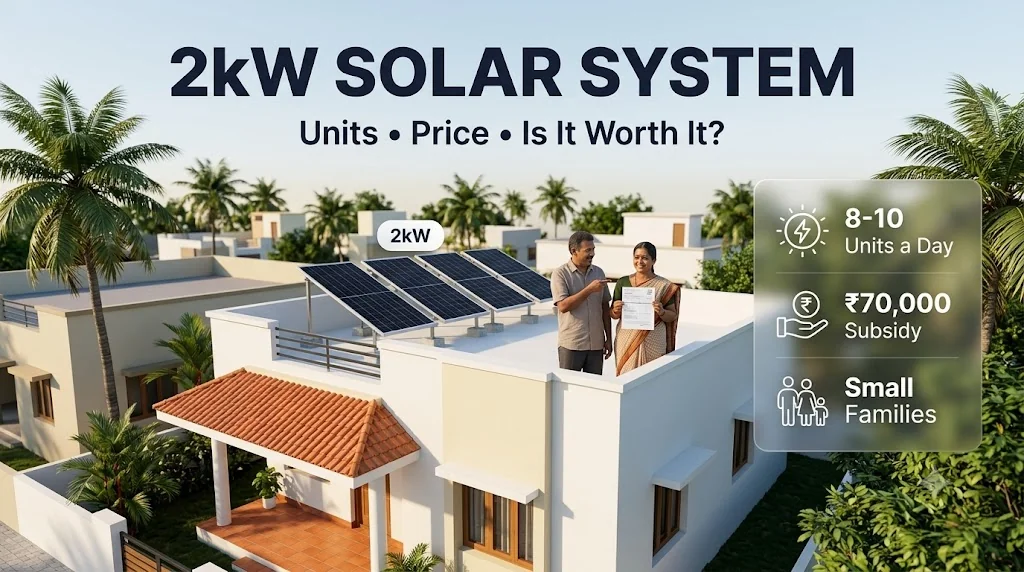
Short answer: a 2kW solar system produces about 8 to 10 units a day in Tamil Nadu, which is 240 to 300 units a month and 2,800 to 3,300 units a year. It gets about ₹70,000 in subsidy (₹60,000 PM Surya Ghar + ₹10,000 Tamil Nadu top-up). It suits small homes with a monthly bill of about ₹1,000 to ₹1,800, but for many families 3kW turns out to be the smarter buy. Here is why.
2kW Solar Units at a Glance
| Period | Units from 2kW (Tamil Nadu) |
|---|---|
| Per day (average) | 8 - 10 units |
| Per day (clear summer day) | 10 - 11 units |
| Per day (cloudy monsoon day) | 5 - 7.5 units |
| Per month (average) | 240 - 300 units |
| Per TNEB bill (2 months) | 480 - 600 units |
| Per year | 2,800 - 3,300 units |
The math: 2 kW × 5.2 peak sun hours × 0.78 performance ratio ≈ 8.1 units on an average day, and close to 11 on bright summer days. Coastal Cuddalore homes sit in the middle of the range; drier Panruti and Neyveli do slightly better.
Month by Month
| Season | Months | Units per day | Units per month |
|---|---|---|---|
| Summer | March - May | 10 - 11 | 300 - 330 |
| Southwest monsoon | June - September | 8.5 - 9.5 | 255 - 290 |
| Northeast monsoon | October - December | 6.5 - 7.5 | 195 - 230 |
| Winter | January - February | 8.5 - 9.3 | 255 - 280 |
The October-December rainy season is the lowest, summer the highest. With a net meter the extra summer units offset the monsoon months. Details in our rain and cyclone guide.
What Can 2kW Run?
| Load | Approx. units per day |
|---|---|
| 6-8 LED lights + 4 fans | 2 - 2.5 |
| Refrigerator | 1 - 1.3 |
| TV, Wi-Fi, laptop, chargers | 0.8 - 1.2 |
| Washing machine, mixer, iron | 0.6 - 1 |
| Water pump (0.5-1 HP, short run) | 0.4 - 0.7 |
| 1 ton inverter AC, about 3-4 hours | 2.5 - 3.5 |
| Total | about 8 - 10 units |
So 2kW covers a 2BHK home with light AC use. If your AC runs most afternoons and nights, the 3kW system is the right size. See can a 1.5 ton AC run on solar.
2kW Price and Subsidy (Tamil Nadu, 2026)
| Amount | |
|---|---|
| Typical market price (on-grid, installed) | ₹1,30,000 - ₹1,45,000 |
| PM Surya Ghar central subsidy | ₹60,000 |
| Tamil Nadu top-up (G.O. 102, eligible homes) | ₹10,000 |
| Approximate real cost | ₹60,000 - ₹75,000 |
Market averages as of October 2026; your exact price comes in a written quote after a free site visit. Subsidy rules: ₹1 lakh solar subsidy in Tamil Nadu.
2kW vs 3kW: The Subsidy Math Most People Miss
| 2kW | 3kW | |
|---|---|---|
| Units per day | 8 - 10 | 12 - 15 |
| Market price (approx.) | ₹1.3 - 1.45 lakh | ₹1.8 - 2.0 lakh |
| Total subsidy (TN) | ₹70,000 | ₹1,00,000 |
| Real cost after subsidy | ₹60,000 - ₹75,000 | ₹80,000 - ₹1,00,000 |
| Cost per daily unit (after subsidy) | about ₹7,500 | about ₹6,700 |
For roughly ₹20,000-25,000 more (after subsidy), 3kW gives you about 50% more units and covers an AC. Unless your roof is small or your usage is genuinely low, 3kW gives more value per rupee.
Check the 200 Free Units First
Since May 2026, Tamil Nadu homes using 500 units or less in a two-month bill get the first 200 units free. If your bimonthly use is around 300-500 units, part of your consumption is already free, and solar saves you mainly the ₹4.50-6.00 units above 200. That still pays back, but the payback is slower than for high-bill homes.
Two good rules of thumb:
- Bimonthly use under 300 units: solar savings are small; consider 1kW-2kW only if you expect usage to grow (new AC, more family members).
- Bimonthly use 500+ units: you are paying the expensive slabs, and 3kW or more pays back fastest.
See how slabs work in our TNEB slab rates guide.
Roof Space and Design
- Panels: four panels of 540-580 watts (older systems used six 330-watt panels).
- Roof area: about 150-200 sq ft of shade-free terrace.
- Structure: a raised hot-dip galvanized structure for coastal homes; it keeps panels cooler and the terrace usable. See structure types.
- Inverter: a 2kW or 3kW on-grid inverter. Choosing a 3kW inverter lets you add panels later.
Tip: if you choose 2kW now because of budget, ask for a 3kW inverter and space reserved on the structure. Adding one or two panels later is cheap, though the subsidy applies only to the capacity in your original application.
Is a 2kW Solar System Worth It?
It depends on your two-month TNEB bill, because the first 200 units are free for homes under 500 units:
| Your two-month bill | Is 2kW worth it? | Typical payback after ₹70,000 subsidy |
|---|---|---|
| Below ₹1,000 | Usually not yet; the free units already cover most use | 10+ years |
| ₹1,000 - ₹2,000 | Borderline; worth it if you plan an AC or more family members | about 7 - 9 years |
| ₹2,000 - ₹3,500 | Yes, especially if you cross 500 units in summer | about 5 - 6 years |
| Above ₹3,500 | Consider 3kW instead: same effort, up to ₹1 lakh subsidy | 3kW pays back faster |
Estimates using TNEB domestic slabs and market-average prices (October 2026). Check your exact bill in the TNEB EB bill calculator and your payback in the solar savings calculator.
Our honest view: 2kW is a good choice for a small home that regularly crosses 500 units in summer, or a home with limited roof space. If your bill is above ₹3,500 every two months, 3kW usually gives better value because the subsidy jumps to up to ₹1 lakh.
Is 2kW Enough for Your Home? Quick Checklist
2kW is likely right if most of these are true:
- Your bimonthly TNEB bill is about 400-600 units in summer.
- You have no AC, or one AC used only a few hours in the evening.
- Your shade-free roof is under about 250 sq ft.
- You do not plan a new AC, EV or big appliance in the next 2-3 years.
If two or more are false, look at 3kW: it gives about 50% more units and ₹30,000 more subsidy for a small extra cost. A free site visit settles it with your real bills and roof measurements.
How to Check a 2kW System Is Working Well
Open your inverter app on a clear day. A healthy 2kW system should show about 9-11 units by evening in summer and 8-9 on normal sunny days. Consistently lower numbers mean dust, new shade or a wiring issue; our maintenance guide explains what to check.
Compare Other Sizes
Solar Savings Calculator Tamil Nadu
Enter your EB bill to see the system size, savings and payback.
Enter amount between ₹2,000 and ₹30,000 • We specialize in 2 kW+ systems
Frequently Asked Questions
Is a 2kW solar system worth it in Tamil Nadu?
How many units does a 2kW solar system produce per day?
What is the subsidy for a 2kW solar system in Tamil Nadu?
Can a 2kW solar system run an AC?
Is 2kW or 3kW better?
How much roof space does a 2kW solar system need?
Not Sure Between 2kW and 3kW?
Send a photo of your last two TNEB bills on WhatsApp (+91 7904369094). We will calculate both options, including your exact subsidy, and recommend the one that pays back faster.
Get a Free Rooftop Assessment
Our engineers will visit your site, analyze shadow-free area, and provide a detailed solar report.
Book Free AssessmentTags
Ready to Switch to Solar?
Get a customized solar solution for your home. Save up to 90% on electricity bills!
- Free Site Visit
- Govt. Subsidy Support
- 25 Years Warranty