
Does Solar Work on Cloudy Days? Tamil Nadu Reality (2026)
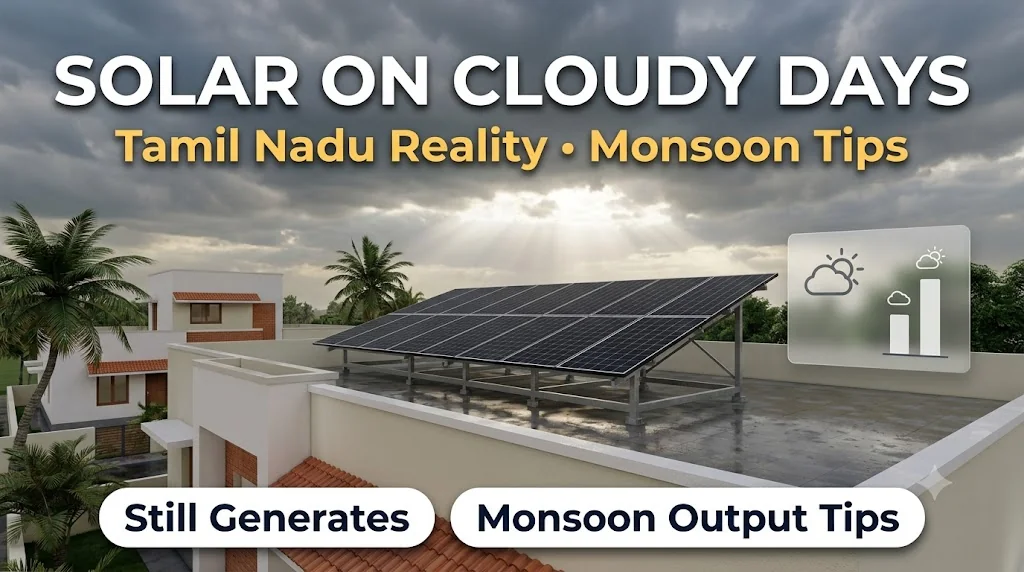
Short answer: yes, solar panels work on cloudy days, just less. Panels turn daylight into electricity, not only direct sunshine. In Tamil Nadu a lightly cloudy day still gives about 70-85% of normal output, a heavily overcast day about 30-60%, and continuous heavy rain about 10-25%. Over a full year, cloudy days reduce total generation by only a small amount, because our sunny months are so strong.
Output by Type of Weather
| Sky | Output vs a clear day | 3kW system, units that day |
|---|---|---|
| Clear blue sky | 100% | 13 - 15 |
| Thin, high clouds / haze | 80 - 90% | 11 - 13 |
| Scattered clouds (sun in and out) | 70 - 85% | 10 - 12 |
| Thick grey overcast | 30 - 60% | 5 - 8 |
| Continuous heavy rain | 10 - 25% | 2 - 4 |
Scattered clouds can even cause short bursts above normal output, when sunlight reflects off cloud edges ("cloud edge effect"). Good inverters handle these spikes.
Why Panels Still Work Under Clouds
Sunlight reaching the ground has two parts:
- Direct light - the beam from the sun. Clouds block much of it.
- Diffuse light - light scattered by the sky and clouds. Even on grey days there is plenty of it.
Panels use both. On an overcast day you lose most direct light but keep diffuse light, which is why output falls but does not stop. Modern TOPCon panels also perform slightly better in low light than older panels. Compare panel types in bifacial vs monocrystalline.
What Cloudy Months Mean Over a Year
Here is how a typical 3kW system in Cuddalore behaves through the year:
| Season | Months | Units per month (3kW) |
|---|---|---|
| Summer | March - May | 450 - 490 |
| Southwest monsoon | June - September | 380 - 430 |
| Northeast monsoon (cloudiest) | October - December | 290 - 340 |
| Winter | January - February | 390 - 420 |
| Yearly total | about 4,500 - 5,000 |
Even the cloudiest quarter delivers about two-thirds of a summer month. Over the year, cloud costs you perhaps 8-12% compared with a "perfect sun" year, which is already built into the generation figures we quote. See the full numbers for each size: 1kW, 2kW, 5kW.
The Net Meter Is Your "Cloud Insurance"
With an on-grid system and a TNEB net meter:
- On sunny days you produce more than you use, and the extra units go to the grid.
- On cloudy days you produce less, and you draw from the grid.
- The meter records both, and TNEB bills only the difference (as per current net metering rules).
So you do not need a battery to "save" sunny days for cloudy ones. The grid does that for you, free. Read the net metering guide.
Do You Need a Bigger System for Cloudy Weather?
Usually no. The right way to size is:
- Add up your units for the last 6 TNEB bills (one year).
- Divide by 365 to get average daily use.
- Divide by about 4.2-4.5 units per kW per day (our yearly average including cloudy months).
Example: a home using 4,200 units a year uses about 11.5 units a day, so 11.5 ÷ 4.3 ≈ 2.7 kW. A 3kW system fits. Use the solar calculator or our sizing guide.
Over-sizing "for cloudy days" only makes sense if you plan to add load (an EV, another AC) in the next year or two.
Myths About Solar and Clouds
| Myth | Reality |
|---|---|
| "Solar gives zero on rainy days" | It gives 10-25% even in heavy rain, more in breaks between showers |
| "Hot sunny days give the most power" | Bright, cooler days give the most; heat reduces panel efficiency |
| "Rain damages panels" | Panels are sealed (IP67/68 junction boxes) and rain actually washes dust off |
| "Batteries fix cloudy days" | Batteries help with power cuts, not low sunshine |
| "Monsoon makes solar a bad deal in Cuddalore" | Yearly generation in Tamil Nadu is among the best in India |
More myths answered in 10 solar myths vs facts.
Cloudy Days vs Power Cuts: Two Different Problems
People often mix these up:
| Problem | What happens to an on-grid system | Solution |
|---|---|---|
| Cloudy day | Produces less; grid fills the gap; net meter balances over the year | Nothing needed |
| Power cut (grid down) | Shuts down for safety, even if sunny | Hybrid system with battery, or a separate home inverter |
If your area has frequent cuts, read on-grid vs hybrid solar for Tamil Nadu. If cuts are rare, on-grid gives the best savings and the full ₹1 lakh subsidy.
How to Get the Most Out of Cloudy Months
- Clean panels right after the rains stop. Rain leaves a muddy, salty film on the coast. A gentle wash restores a few percent.
- Run heavy loads in the brightest hours (11 AM - 2 PM): washing machine, water pump, iron.
- Check your inverter app. A big drop on a bright day after rain can mean a tripped connection or water in a junction box; call your installer.
- Keep the structure tilted at 10-15°, so rain runs off and dirt does not settle.
Frequently Asked Questions
Do solar panels work on cloudy days?
Do solar panels work at night or in moonlight?
How many cloudy days does Tamil Nadu have?
Should I buy a bigger system because of cloudy days?
Do batteries help on cloudy days?
Plan Your System With Real Local Numbers
We size every system using year-round Cuddalore and Puducherry generation, cloudy months included, so your savings estimate is realistic. With the ₹1 lakh subsidy available for a limited time, now is a good time to check. Call or WhatsApp +91 7904369094.
Get a Free Rooftop Assessment
Our engineers will visit your site, analyze shadow-free area, and provide a detailed solar report.
Book Free AssessmentTags
Ready to Switch to Solar?
Get a customized solar solution for your home. Save up to 90% on electricity bills!
- Free Site Visit
- Govt. Subsidy Support
- 25 Years Warranty